





Perfume notes help you understand a scent’s direction, but they do not describe the whole purchase. Read the opening, heart and base together, then separate that description from the ingredient list and the oil or spray format you are buying. A search for “vanilla perfume” or “rose fragrance” becomes more useful when you read beyond one familiar word.
What do top, heart and base mean?
Jo Malone’s explanation of perfume notes divides the description into three parts: the opening impression, the heart that expresses the scent’s character, and the base associated with its continuing impression. This is a useful reading framework, not an identical timetable for every perfume.
Do not stop at the first note you enjoy. Citrus in the opening does not describe the entire fragrance, and vanilla in the base does not make all vanilla-listed scents alike. Read the surrounding words and ask what direction the description suggests as a whole.
Three different kinds of information
- Notes: words describing the fragrant impression, such as rose, vanilla and woods.
- Ingredients: the product’s listed materials, rather than another version of its scent story.
- Purchase format: perfume oil or spray, in a stated weight or volume. A musky or citrus description does not determine that format.
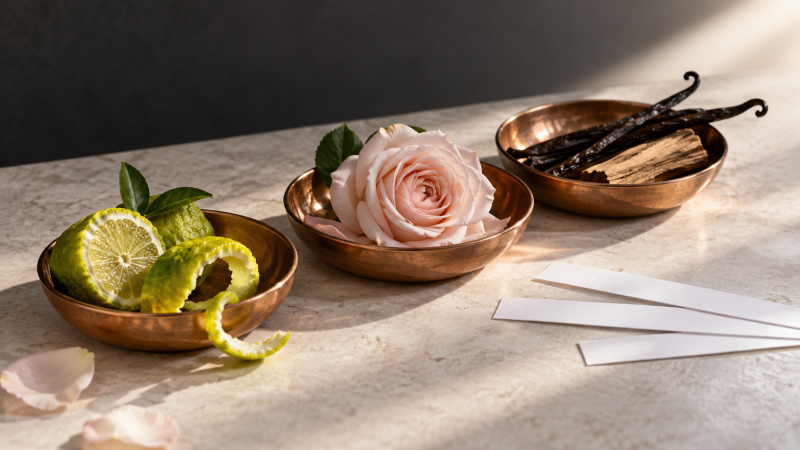
The official Althaïr page illustrates this distinction by separating its olfactive pyramid from its Ingredients section. A flower or fruit photograph is therefore not evidence of formula percentages or proof that the entire perfume consists of those extracts. For a question about a particular material, consult the actual product information rather than interpreting the note list as a recipe.
A practical reading checklist
- Read the full name and edition. An extra word may identify a different release; keep it in your search.
- Write two or three preferences. For example, fruity and rosy, or vanilla and spice. These describe your priorities, not a quality ranking.
- Read the heart and base as well. Look for the surrounding character instead of counting how many favourite words appear.
- Check the actual purchase. Confirm oil or spray, then the size or weight and the price for that selection.
For an Arabiva example, someone interested in fruit and rose can read Celia All Over Spray; someone exploring vanilla and spice can read Ashlesha. This is a reading exercise across two different directions, not a claim that one is better or that their formats are interchangeable.
Turn the description into a useful observation
Instead of writing “I could not identify every ingredient”, record what helps your next decision: you liked the overall character, wanted more floral presence, or preferred less sweetness. You do not have to name each note to know your preference. Keep the product name and format beside your observations so that you do not confuse an oil with a spray or one edition with another.
Use the notes to shorten your list, then consult our perfume selection guide. Our oil and spray guide explains the format choice. The All Over Spray collection presents Arabiva names and their own scent descriptions, with current ordering choices on each product page.
Can a note list predict longevity?
Do not treat the number of base notes as a number of hours, or a note pyramid as a laboratory comparison between products. Use the description to explore character, product details to understand format and quantity, and your actual experience to decide what suits you.
Arabiva editorial team · 27 September 2026. Sources and catalogue checked on this date. The generated cover illustrates scent notes rather than the ingredients of a specific formula.
For a precise reference-reading example, see Hypnotic Poison and Puppis Alba.
To separate a scent description from ingredient function, see solubiliser versus preservative. For edition-name precision, explore Barénia Pleine Fleur versus Barénia.
For an edition-specific example, read the J’adore Intense and Procella reference guide.
Explore Imagination’s direction and Arabiva Zona’s reference.