





Does an oil-and-water mixture become ready to use simply because it looks clear? No. Solubilisation concerns how an oily component is distributed; preservation concerns microbial control. A clear appearance does not establish adequate preservation, and adding a preservative does not automatically resolve oil separation. Keeping these questions separate makes ingredient selection more useful.
Describe the problem before choosing an ingredient
Record what you actually observe: an oil layer, cloudiness, sediment or a change during storage. These are different observations, not a diagnosis. Note the intended product, ingredient identities and weighed amounts. “What should I add?” is a better question when it refers to a defined system rather than an unspecified online recipe.
This is an ingredient-role guide, not a ready-to-use body-spray formula or permission to apply an experimental mixture to skin. Buying a finished daily-use product is a different decision from developing a formula with raw materials.
Three separate decisions
- Distribution: how will the oily component behave within the system?
- Preservation: is the preservation system appropriate for the finished formula, packaging and use?
- Sensory result: what scent or feel is intended? A pleasant result does not establish the first two.
Where do Polysorbate 20 and 80 fit?
Croda identifies Polysorbate 20 as a solubilising and emulsifying ingredient for suitable systems. That explains a role, not a universal addition ratio. Oil identity, loading and the rest of the system can change the outcome.
Compare Arabiva’s Polysorbate 20 and Polysorbate 80 by their described roles and available packs. The higher number does not automatically mean a better choice. Neither name establishes that a mixture is microbiologically preserved. Supplier specifications and testing of the actual formula matter.
Where does a preservative fit?
Phenoxyethanol is considered within preservation systems; the European Scientific Committee on Consumer Safety discusses its preservative use. An assessment of an ingredient does not replace evaluation of your finished formulation.
Vitamin E acetate should not be treated as a substitute for microbial preservation. Likewise, do not assume that an unidentified ready base is preserved or can accept arbitrary extra water and fragrance. Obtain the supplier’s instructions for that base.
A practical purchasing record
- Define whether you need a trial ingredient or a documented ready base.
- List the separate roles your project requires.
- Check technical identity and batch specifications rather than relying on a trade name.
- Choose enough material for small weighed trials.
- Record the variable changed before scaling your next purchase.
At this review, Arabiva’s Kuwait listings offer both Polysorbates in 120 g, 250 g and 1 kg packs. These are purchasing sizes, not addition percentages. Grams measure weight and are not automatically equivalent to millilitres. Check each listing for current options and prices.
Is shaking enough to solve separation?
Shaking can change appearance temporarily; it does not establish suitability or stability. A photograph immediately after shaking is not a complete assessment. Keep a trial record and obtain appropriate formulation evaluation before moving towards a product for use or sale.
Use the raw-material selection guide to organise choices by role. Its related products are comparison aids, not a complete recipe to mix together.
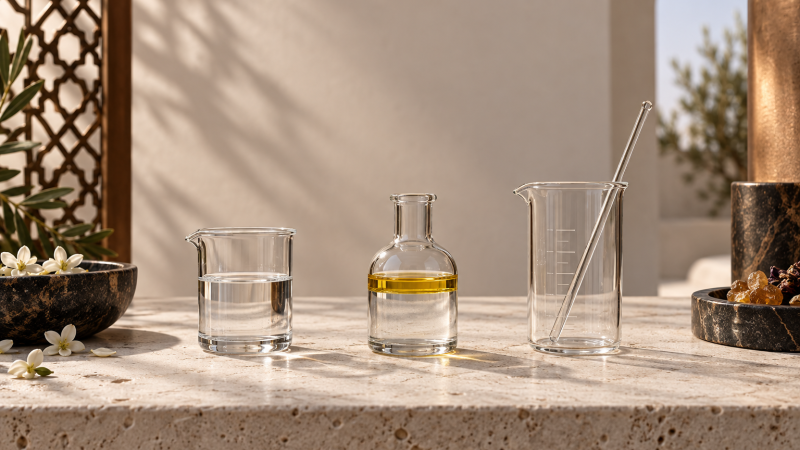
Arabiva editorial team · Reviewed 3 October 2026. The generated cover is illustrative, not a laboratory test result.